Most business owners I talk to in Dubai use the words "web design" and "web development" to mean the same thing. They are not the same thing. Understanding the difference helps you ask better questions, hire the right people, and avoid paying for things you do not need or missing things you do.
This guide is about web development specifically: what it means, what it covers, what it costs in Dubai, and what to check before you hire anyone.
Web design vs web development: what is actually different
Here is the simplest way I can put it.
Web design is how a site looks. The colours, the fonts, the layout, the spacing, the images, the way a page is structured to guide a visitor from one section to the next. A designer produces a visual plan for what your site will be.
Web development is how a site is built and how it works. A developer takes that visual plan and writes code that runs in a browser. That code creates the buttons, makes the forms send emails, handles the login system, connects to a payment processor, and makes sure the page loads fast on a phone in Dubai at 2pm with patchy mobile data.
One is a creative process. The other is a technical process. Both matter.
| Web design | Web development | |
|---|---|---|
| Main question | What does it look like? | How does it work? |
| Output | Visual mockups, colour palettes, layouts | Code, databases, integrations |
| Tools | Figma, Adobe XD, Photoshop | JavaScript, HTML, CSS, Python, PHP |
| Who does it | Designers | Front-end and back-end developers |
| Result without the other | Beautiful mockups that do not work | A working site that looks like it was built in 2004 |
A good agency handles both. You should not have to hire a designer separately from a developer and hope they communicate. Get a team that does both under one roof, gives you one point of contact, and takes responsibility for the finished product.
What "front-end" and "back-end" mean
You will hear these two terms constantly when talking to developers. Here is what they mean in plain English.
Front-end is everything you can see and click in your browser. The menu, the buttons, the text, the images, the form you fill in. When a developer says "I work on the front-end" they mean they write the code that creates what the visitor sees and interacts with.
Back-end is everything that happens behind the scenes. When you fill in a form and click submit, something needs to receive that data, store it, and send you a confirmation email. When a customer places an order, something needs to update the inventory, charge the card, and send a receipt. That is the back-end. It runs on a server, not in the visitor's browser.
Some developers do both front-end and back-end. They are called full-stack developers. For most Dubai business websites, you need a developer who can handle both.
What is a CMS and do you need one
CMS stands for content management system. It is software that lets you update your website without touching any code.
Without a CMS, if you want to change a price, update a service description, or add a new team member, you need to ask your developer to do it every single time. That gets expensive and slow.
With a CMS, you log in to a simple dashboard that looks roughly like a word processor. You click on the page you want to change, update the text, and save. The change goes live immediately.
WordPress is the most widely used CMS in the world. It runs roughly 40 percent of all websites. Contentful, Sanity, and Prismic are newer options that are faster and cleaner but require more technical setup. Shopify has its own built-in CMS for e-commerce.
For most Dubai service businesses, you want a site with a CMS you can use yourself. If your developer builds a site with no CMS and hands it to you as a static set of files, you will be dependent on them forever. Ask about this before you hire.
What is hosting
Your website files live on a computer somewhere in the world called a server. Hosting is the service that keeps that server running 24 hours a day so that when someone in Dubai types your web address, the files load in their browser.
You pay for hosting either monthly or annually. Prices range from AED 50 a month for shared hosting (your site shares a server with hundreds of other sites) to AED 500 and above for a dedicated server or a premium cloud setup.
For most small Dubai businesses, mid-tier cloud hosting on platforms like AWS, Google Cloud, or Vercel gives you the best mix of speed and reliability without a huge monthly bill. Your developer should recommend and set this up for you. You should own the hosting account, not them.
Three types of websites and what each needs
Not all websites are the same. The type you need determines the scope of the development work and the cost.
Brochure site
This is the most common type for Dubai service businesses. A brochure site has five to ten pages: home, about, services, maybe a few sub-pages for individual services, and a contact page. Its job is to present your business clearly and make it easy for the right people to get in touch.
Development work for a brochure site is mostly front-end. You need clean code, fast load times, a contact form, a WhatsApp button, and a CMS so you can update content yourself. A good brochure site for a Dubai business should take four to six weeks to build. At Markamo a business website is a fixed one-time project from AED 4,000, with a focused landing page from AED 2,500. Our complete guide to web design in Dubai breaks down what each tier includes.
E-commerce site
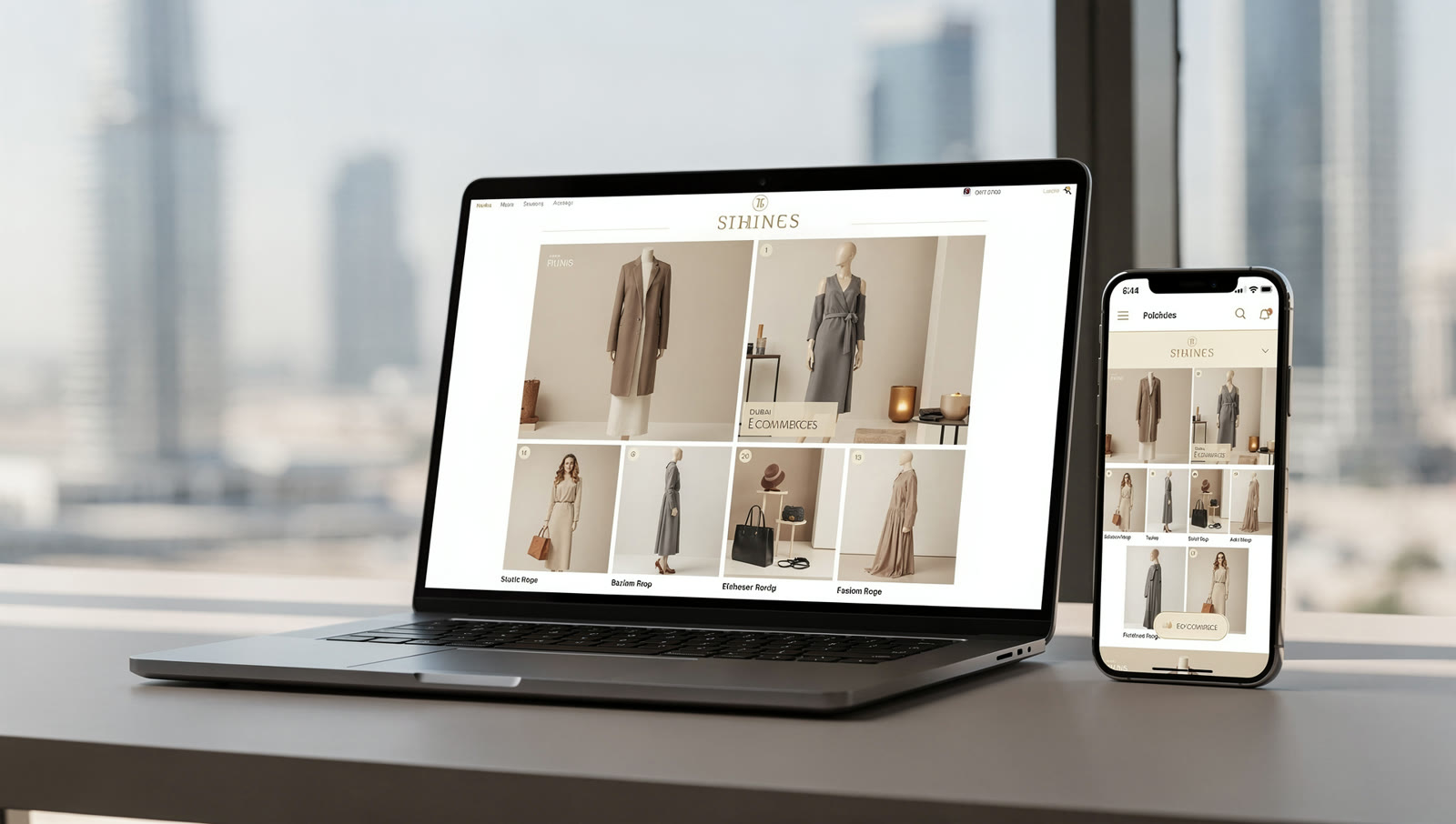
An e-commerce site lets visitors browse products, add them to a cart, and pay online. It needs a product catalogue, a shopping cart, a payment gateway (a service that processes card payments securely, like Stripe or PayTabs), order management, and usually an inventory system.
This is significantly more development work than a brochure site. A basic e-commerce store in Dubai costs from AED 15,000 upward. A store with hundreds of products, custom filters, Arabic language support, and integrations with a local courier typically costs AED 30,000 to AED 60,000 or more. Timelines run from eight to sixteen weeks.
Shopify is a good starting point for most Dubai e-commerce businesses because it handles hosting, security, and payment processing out of the box. WooCommerce (built on WordPress) gives you more flexibility but requires more ongoing technical maintenance.
Web application
A web application is a site that does something complex: it might let users create accounts, save data, manage bookings, run reports, or interact with other software systems. Think of a booking system for a clinic, a property portal, or a client dashboard for a logistics company.
This is full software development. It requires both front-end and back-end work, a database (a structured system for storing and retrieving data), and careful planning before a single line of code is written. Costs for a custom web application in Dubai typically start at AED 50,000 and can run into the hundreds of thousands for complex systems. Timelines are months, not weeks.
Most Dubai SMEs do not need a custom web application. If someone is trying to sell you one when a brochure site would do the job, ask them why.

What good web development actually looks like
A site being "built" does not automatically mean it is built well. Here is what matters.
Load speed
Speed is not just about user experience. Google uses page speed as a ranking factor. A site that takes five seconds to load on a mobile connection in Dubai loses visitors and loses rankings. Ask for a PageSpeed Insights score on any site your potential agency shows you as a reference. A score above 80 on mobile is a reasonable benchmark.
A site loads fast when images are properly compressed, code is clean and minimal, the server is close to your visitors, and unnecessary scripts are not slowing everything down. These are developer choices. They do not happen automatically.
Mobile-first build
More than 70 percent of web traffic in the UAE comes from mobile devices. A site that looks fine on a laptop but is hard to use on a phone is a site that is failing the majority of its visitors. Good developers build for mobile first and then adapt for larger screens, not the other way around.
SEO-ready structure
Developers make choices that affect how Google reads your site. Clean page titles, proper heading structure (one H1 per page, logical H2s and H3s), descriptive image labels, fast load times, and a clear sitemap all help Google understand what your site is about. These are not things you can add after the fact. They need to be built in from the start.
A site that is SEO-ready gives your content work a solid foundation. A site that is not SEO-ready can hold back your rankings regardless of how much you spend on content.
Ads-ready structure
If you are running Google Ads or Meta Ads (Facebook and Instagram ads), your website matters more than most people realise. Google assigns a Quality Score to every ad based partly on the page you are sending traffic to. A slow, poorly structured landing page raises your cost per click and lowers your ad position. A fast, clear page with a strong call to action lowers your costs and gets you better results for the same budget.
Good web development, with fast load times and clear conversion paths, makes your ad spend work harder.
What to check before you hire a web development agency in Dubai
I get asked this a lot. Here is what I actually look at.
Do you own the code? This is non-negotiable. If the agency builds your site on a platform where they own the code or the theme and you cannot take it with you, you are renting not buying. Ask this question directly: "If I leave, can I take the full code and all design files with me?" The answer should be yes without hesitation.
Who owns the domain and hosting accounts? Your domain name (the web address) and your hosting account should be registered in your name, not the agency's. Some agencies register domains in their own name and hold clients hostage. Check this.
Can you see three live sites they built and test them on your phone? Open each one on a mobile connection. Does it load quickly? Is it easy to read? Does the form work? If the sites they show you do not work well on mobile, yours will not either.
What happens after launch? Websites need maintenance. Security updates, bug fixes, speed checks, content updates. Ask what the ongoing arrangement is. Monthly retainers for web maintenance in Dubai typically run from AED 500 to AED 3,000 depending on scope.
Can you update content yourself? You should be able to update your own text, images, and basic content without calling a developer. If the answer is no, ask why.
Who do you speak to when something breaks? An agency that has a team in Dubai and a clear response time commitment is much better than a freelancer who goes dark for a week. Ask directly: what is your response time for urgent issues?
How we do it at Markamo
I built Markamo around the businesses I saw getting poor value from web projects in Dubai. Sites that looked good in a presentation but loaded slowly on mobile. Code that belonged to the agency. Hosting accounts the client could not access. Developers who disappeared after launch.
We build sites that load fast, score well on mobile, are ready for ads and SEO from day one, and belong entirely to you. You get a founder-level point of contact. You get a response within one business day. Our web design service is priced as a fixed one-time quote you approve before any work begins, starting from AED 2,500 for a landing page and AED 4,000 for a business website, and the finished site is yours to keep. If you want to leave, you can take your site and everything connected to it with you.
We are not the right fit for every project. If you need a full custom web application with complex integrations, we will tell you that honestly and point you toward someone better suited. But for Dubai service businesses, clinics, agencies, and e-commerce brands that need a fast, professional site that works for both SEO and ads, this is what we do and we are straightforward about how we do it.
You can see our full pricing or get in touch on the homepage if you want to talk through your project.
A quick note on timelines
The most common reason web projects run late in Dubai is not the developer. It is the client.
Development agencies need content: page copy, team photos, service descriptions, logos in the right format, product images, and a list of what you want on each page. When clients take three weeks to provide a logo and six weeks to write their about page, the project runs late.
If you want your site to launch on time, treat content delivery as your job. Show up to review meetings prepared. Give feedback in one round where possible. The agencies that deliver on time are the ones whose clients do the same.
What you should do next
If you are evaluating web development services in Dubai, start by getting clear on what type of site you need: brochure, e-commerce, or web application. Your answer determines who to talk to and what a realistic budget looks like.
Then ask the right questions before you sign anything: do you own the code, who holds the domain and hosting accounts, can you see live sites they built, and what is the ongoing support arrangement.
If you want to talk through your project with someone who will give you a straight answer, you can reach us through the homepage. We reply within one business day.